
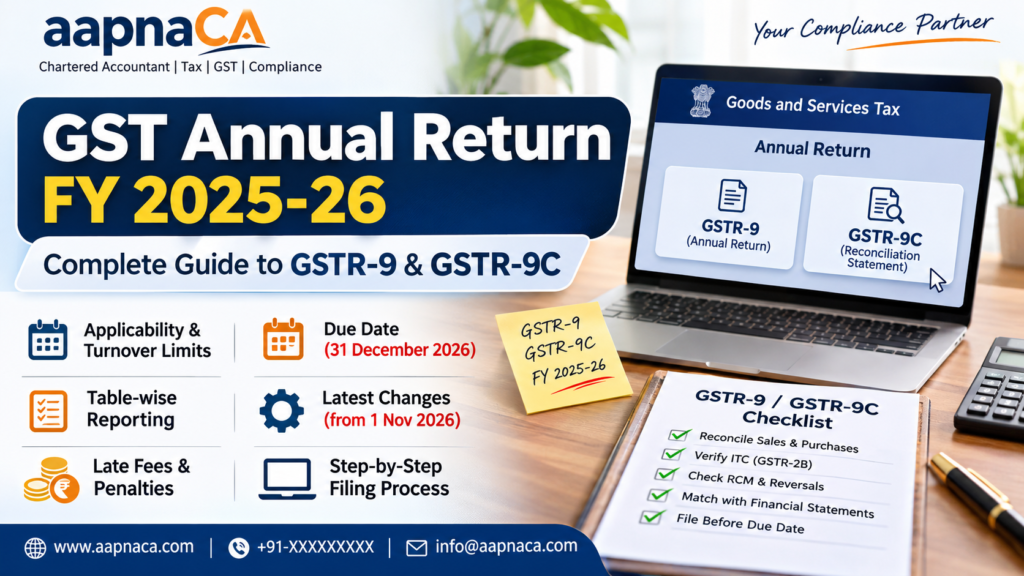
The GST Annual Return is one of the most important statutory compliance requirements for businesses registered under the Goods and Services Tax (GST) regime in India.
With the deadline of 31 December 2026 approaching, businesses must ensure that their GST returns, financial statements, Input Tax Credit (ITC) and tax liabilities are properly reconciled before filing their annual returns for FY 2025-26.
The Central Board of Indirect Taxes and Customs (CBIC) has also extended certain reporting relaxations in GSTR-9 and GSTR-9C through Notification No. 05/2026-Central Tax, applicable from 1 November 2026.
This comprehensive guide explains everything taxpayers need to know about GST annual return filing for FY 2025-26.
1. What is GST Annual Return?
GST Annual Return is a consolidated statement of transactions undertaken by a registered taxpayer during a financial year.
It is governed by Section 44 of the CGST Act, 2017, read with Rule 80 of the CGST Rules, 2017.
The annual return includes details of:
- Outward supplies and sales.
- Inward supplies and purchases.
- Input Tax Credit claimed, reversed and reclaimed.
- GST payable and GST paid.
- Exempted, nil-rated and non-GST supplies.
- Reverse Charge Mechanism (RCM) transactions.
- Refunds and demands.
- Amendments relating to the financial year.
- HSN-wise summary of supplies.
The primary objective of the annual return is to consolidate GST-related transactions and identify discrepancies in periodic returns.
2. What is GSTR-9?
GSTR-9 is the annual GST return filed by eligible regular registered taxpayers.
It consolidates the information reported during the financial year through GSTR-1, GSTR-1A, GSTR-3B and other relevant GST records.
It enables taxpayers to review their annual turnover, tax liability, Input Tax Credit and overall GST compliance.
3. What is GSTR-9C?
GSTR-9C is a self-certified reconciliation statement that compares the information reported in GSTR-9 with the audited annual financial statements of the taxpayer.
It primarily covers:
- Reconciliation of gross turnover.
- Reconciliation of taxable turnover.
- Reconciliation of GST liability.
- Reconciliation of Input Tax Credit.
- Identification and explanation of unreconciled differences.
- Additional tax liability, if any.
GSTR-9C is no longer required to be separately certified by a Chartered Accountant or Cost Accountant. However, professional assistance is advisable to ensure accurate reconciliation and reporting.
4. Applicability of GSTR-9 and GSTR-9C for FY 2025-26
The applicability of GST annual returns depends on the aggregate turnover of the registered taxpayer during the financial year.
| Aggregate Annual Turnover | GSTR-9 | GSTR-9C |
|---|---|---|
| Up to ₹2 crore | Exempted | Not applicable |
| Above ₹2 crore and up to ₹5 crore | Mandatory | Not applicable |
| Above ₹5 crore | Mandatory | Mandatory |
As per Notification No. 15/2025-Central Tax dated 17 September 2025, registered taxpayers having aggregate turnover up to ₹2 crore are exempted from filing GSTR-9 for FY 2024-25 onwards.
How is aggregate turnover calculated?
Aggregate turnover is calculated on an all-India PAN basis and includes:
- Taxable supplies.
- Exempt supplies.
- Nil-rated supplies.
- Non-taxable supplies.
- Export of goods and services.
- Inter-state supplies, including qualifying supplies between distinct persons.
However, GST and compensation cess charged on supplies and the value of inward supplies liable to reverse charge are excluded.
Although applicability is determined on a PAN basis, the annual return must be filed separately for each applicable GST registration (GSTIN).
Example:
A business has three GST registrations:
- Delhi: ₹2.50 crore
- Haryana: ₹1.75 crore
- Uttar Pradesh: ₹1.25 crore
The aggregate turnover is ₹5.50 crore. Accordingly, both GSTR-9 and GSTR-9C are applicable to all three regular GST registrations.
5. GST Annual Return Due Date for FY 2025-26
| Particulars | Details |
|---|---|
| Financial year | 2025-26 |
| Reporting period | 1 April 2025 to 31 March 2026 |
| GSTR-9 due date | 31 December 2026 |
| GSTR-9C due date | 31 December 2026 |
| Statutory deadline for eligible missed ITC | 30 November 2026 or filing of annual return, whichever is earlier |
The due date is subject to any subsequent extension notified by the Government.
Taxpayers should avoid waiting until the last date to complete their annual GST compliance.
6. Who is Not Required to File GSTR-9?
The following categories of taxpayers are generally not required to file GSTR-9:
- Taxpayers with aggregate turnover up to ₹2 crore for FY 2025-26.
- Composition scheme taxpayers for the period covered under the composition scheme.
- Input Service Distributors (ISD).
- Casual taxable persons.
- Non-resident taxable persons.
- Persons registered solely for deducting TDS under GST.
- Persons registered solely for collecting TCS under GST.
- Government departments and local authorities covered by the statutory exemption under Section 44.
Composition taxpayers are subject to separate annual return requirements through GSTR-4.
7. Latest Changes in GSTR-9 and GSTR-9C for FY 2025-26
CBIC issued Notification No. 05/2026-Central Tax dated 26 October 2026, effective from 1 November 2026, extending specified reporting relaxations for FY 2025-26 onwards.
The objective is to simplify annual return preparation and reduce unnecessary reporting requirements.
Key changes and continuing relaxations
- Specified categories of supplies may be reported on a consolidated basis.
- Certain credit notes, debit notes and amendments may be adjusted against the original reporting categories.
- Specified classifications of ITC may be consolidated.
- Reporting of refund and demand details remains optional.
- HSN-wise details of inward supplies remain optional.
- Specified turnover reconciliation adjustments in GSTR-9C may be consolidated.
- Expense-wise ITC reconciliation in Table 14 of GSTR-9C remains optional.
However, taxpayers must ensure accurate reporting of mandatory tables, particularly ITC reversals, tax liability and previous-year transactions disclosed during the subsequent financial year.
8. GSTR-9: Table-Wise Reporting Requirements
| Table | Particulars | Reporting Status |
|---|---|---|
| 1 to 3 | Basic taxpayer information | Mandatory/Auto-populated |
| 4 | Supplies and advances on which tax is payable | Mandatory |
| 5 | Supplies on which tax is not payable | Mandatory with specified relaxations |
| 5H to 5K | Credit notes, debit notes and amendments | Consolidation permitted |
| 6 | Details of ITC availed | Mandatory with specified relaxations |
| 7 | ITC reversed and ineligible ITC | Mandatory |
| 8 | Other ITC-related information | Mandatory |
| 9 | Details of tax paid | Mandatory |
| 10 and 11 | Previous-year outward supply amendments | Mandatory, wherever applicable |
| 12 and 13 | Previous-year ITC reversed or availed subsequently | Mandatory, wherever applicable |
| 14 | Differential tax paid | Mandatory, wherever applicable |
| 15 | Refunds and demands | Optional |
| 16 | Specified inward supplies and other information | Optional |
| 17 | HSN-wise summary of outward supplies | Mandatory as applicable |
| 18 | HSN-wise summary of inward supplies | Optional |
| 19 | Late fee payable and paid | Wherever applicable |
Important points for ITC reporting
Taxpayers should pay particular attention to:
- Table 6A1: ITC relating to the preceding financial year claimed during the current financial year.
- Table 6A2: Current-year ITC after the prescribed adjustment.
- Table 6H: ITC reclaimed under applicable provisions.
- Table 7: Separate reporting of prescribed ITC reversals.
- Table 8A: ITC information based on GSTR-2B.
- Tables 12 and 13: Relevant ITC reversals and availment in the subsequent financial year.
Tables 12 and 13 should not be netted against each other.
9. GSTR-9C: Table-Wise Reporting Requirements
| Table | Particulars | Reporting Status |
|---|---|---|
| 5A | Turnover as per audited financial statements | Mandatory |
| 5B to 5N | Turnover reconciliation adjustments | Specified consolidation permitted in Table 5O |
| 6 | Reasons for unreconciled turnover | Wherever applicable |
| 7 | Reconciliation of taxable turnover | Mandatory |
| 8 | Reasons for unreconciled taxable turnover | Wherever applicable |
| 9 | Reconciliation of tax liability | Mandatory |
| 10 | Reasons for unreconciled tax liability | Wherever applicable |
| 11 | Additional tax payable | Wherever applicable |
| 12 | Reconciliation of ITC | Mandatory |
| 13 | Reasons for unreconciled ITC | Wherever applicable |
| 14 | Expense-wise ITC reconciliation | Optional |
| 15 and 16 | ITC differences and related liability | Wherever applicable |
| 17 | Late fee payable and paid | Wherever applicable |
Optional reporting does not exempt taxpayers from maintaining proper books of accounts and supporting reconciliation statements.
10. Late Fees for Delay in Filing GST Annual Return
Late fees are applicable under Section 47(2) of the CGST Act, 2017, read with Notification No. 07/2023-Central Tax dated 31 March 2023 and corresponding State or UT GST provisions.
| Aggregate Turnover | Combined Late Fee Per Day | Maximum Combined Late Fee |
|---|---|---|
| Up to ₹2 crore | Not applicable for exempt taxpayers | Not applicable |
| Above ₹2 crore and up to ₹5 crore | ₹50 | 0.04% of turnover in the State/UT |
| Above ₹5 crore and up to ₹20 crore | ₹100 | 0.04% of turnover in the State/UT |
| Above ₹20 crore | ₹200 | 0.50% of turnover in the State/UT |
Late fee calculation example
Suppose a taxpayer has an aggregate turnover of ₹8 crore and completes the applicable annual return filing 20 days after the due date.
- Late fee per day: ₹100
- Number of delayed days: 20
- Total late fee: ₹2,000, subject to the applicable maximum limit.
Late fee on delayed GSTR-9C
As clarified through Circular No. 246/03/2025-GST dated 30 January 2025, where GSTR-9C is applicable, annual return compliance is considered complete only after both GSTR-9 and GSTR-9C are filed.
Therefore, late fees may continue until GSTR-9C is filed, even if GSTR-9 was filed within the due date.
There is no separate double levy of late fees merely because both forms are applicable.
11. Important GST Reconciliations Before Annual Return Filing
Sales reconciliation
Reconcile outward supplies reported in:
- Books of accounts.
- GSTR-1 and GSTR-1A.
- GSTR-3B.
- E-invoice records.
- E-way bill records.
- Financial statements.
Identify differences relating to unreported invoices, incorrect taxable values, GST rates, credit notes and amendments.
Input Tax Credit reconciliation
Reconcile ITC appearing in:
- Purchase register.
- GSTR-2B.
- GSTR-3B.
- Electronic credit ledger.
- Import documents and bills of entry.
Identify excess ITC, missed eligible ITC, duplicate claims, blocked credits and incorrect ITC reversals.
Reverse Charge Mechanism reconciliation
Review transactions liable to RCM, including applicable:
- Legal services.
- Goods Transport Agency services.
- Import of services.
- Commercial property rent from unregistered suppliers.
- Director services.
- Other notified transactions.
Ensure that tax liabilities have been correctly discharged and eligible credits have been appropriately claimed.
GST rate reconciliation
During FY 2025-26, significant GST rate changes became effective from 22 September 2025.
Businesses should verify the applicable GST rates before and after the effective date and report HSN-wise transactions under the appropriate tax rates.
ITC reversal reconciliation
Verify reversals under applicable provisions, including:
- Rule 37: Non-payment to suppliers within the prescribed period.
- Rule 37A: Specified supplier return-filing defaults.
- Rules 42 and 43: Common ITC attributable to exempt or non-business use.
- Section 17(5): Blocked Input Tax Credit.
12. Documents Required for GSTR-9 and GSTR-9C
Taxpayers should keep the following documents ready before filing:
- GST registration certificate.
- GSTR-1, GSTR-1A and GSTR-3B returns.
- GSTR-2B statements.
- Sales and purchase registers.
- Trial balance.
- Balance sheet and profit and loss account.
- Audited financial statements, wherever required.
- Debit notes and credit notes.
- Electronic cash, credit and liability ledgers.
- E-invoice and e-way bill records.
- Export and import documents.
- Reverse charge working papers.
- ITC reconciliation statements.
- GST refund and demand details.
- DRC-03 payment acknowledgements.
- HSN and SAC-wise supply details.
13. How to File GSTR-9 Online
Follow these steps to file your GST Annual Return:
- Visit the official GST portal at www.gst.gov.in.
- Log in using your registered credentials.
- Navigate to Services > Returns > Annual Return.
- Select Financial Year 2025-26.
- Open the GSTR-9 preparation option.
- Download the system-generated return summaries.
- Reconcile the auto-populated information with your books.
- Complete the applicable tables.
- Calculate and discharge applicable late fees.
- Preview and verify the annual return.
- Submit and file using DSC or EVC, as applicable.
- Download the acknowledgement and filed return.
- Complete GSTR-9C filing wherever applicable.
Ensure all relevant periodic GST returns for the financial year have been filed before initiating annual return filing.
14. Can GSTR-9 and GSTR-9C Be Revised?
No. Once GSTR-9 or GSTR-9C has been filed, there is no general facility to revise it.
Taxpayers must carefully verify all figures before submitting their annual returns.
If additional tax liability is identified, the applicable liability and interest should be discharged through the prescribed mechanism, generally Form GST DRC-03, as appropriate.
Filing GSTR-9 does not provide a fresh opportunity to claim missed Input Tax Credit after the statutory deadline.
15. Common Mistakes to Avoid While Filing GST Annual Return
- Filing returns without reconciling financial statements.
- Incorrect calculation of aggregate turnover.
- Ignoring differences between GSTR-1 and GSTR-3B.
- Claiming ineligible or blocked Input Tax Credit.
- Incorrect reporting of reverse charge transactions.
- Ignoring ITC reversals under Rules 37, 37A, 42 and 43.
- Incorrect reporting of exempt or non-GST supplies.
- Incorrect HSN codes and GST rates.
- Treating auto-populated figures as automatically correct.
- Filing GSTR-9 without filing applicable GSTR-9C.
- Missing the statutory filing deadline.
Proper reconciliation can significantly reduce the risk of discrepancies, additional tax demands and GST scrutiny notices.
16. Frequently Asked Questions (FAQs)
Is GSTR-9 mandatory for turnover below ₹2 crore?
No. Taxpayers having aggregate turnover up to ₹2 crore are exempted from filing GSTR-9 for FY 2025-26.
What is the last date for GST Annual Return FY 2025-26?
The statutory due date is 31 December 2026, unless extended by the Government.
Is CA certification mandatory for GSTR-9C?
No. GSTR-9C is a self-certified reconciliation statement. Taxpayers may obtain professional assistance for accurate preparation and filing.
Can missed ITC be claimed through GSTR-9?
No. GSTR-9 does not allow fresh availment of missed ITC.
Is GSTR-9C mandatory for turnover of exactly ₹5 crore?
No. GSTR-9C becomes mandatory only when aggregate turnover exceeds ₹5 crore.
Is annual return filing GSTIN-wise or PAN-wise?
Applicability is determined on a PAN basis, while filing is undertaken separately for each applicable GSTIN.
Can a GST annual return be filed after the due date?
Yes, subject to applicable late fees and the statutory time restriction under Section 44(2) of the CGST Act.
How long should GST records be maintained?
Generally, GST records must be retained for 72 months from the due date of furnishing the annual return, subject to longer retention requirements in specified proceedings.
17. How aapnaCA Can Help You
At aapnaCA, we provide professional assistance to businesses in managing their GST annual return compliance.
Our services include:
- GSTR-9 preparation and filing.
- GSTR-9C reconciliation and filing assistance.
- GST turnover reconciliation.
- GSTR-2B and ITC reconciliation.
- Reverse charge compliance review.
- GST liability verification.
- Identification of GST mismatches.
- GST notice and departmental query assistance.
- GST advisory and ongoing compliance support.
Whether you are a startup, MSME, trader, manufacturer, service provider or an established business, timely and accurate GST compliance is essential.
Conclusion
GST Annual Return filing is more than a statutory requirement. It is an opportunity for businesses to review their overall GST compliance, identify discrepancies and minimise future tax risks.
With the filing deadline of 31 December 2026 approaching, taxpayers should initiate their reconciliation process at the earliest.
Need assistance with GSTR-9 or GSTR-9C filing for FY 2025-26?
Contact aapnaCA today for professional GST reconciliation, annual return filing and compliance assistance.
Stay compliant. Stay confident. Grow your business with aapnaCA.
Legal References:
- Section 44 and Section 47 of the CGST Act, 2017.
- Rule 80 of the CGST Rules, 2017.
- Notification No. 07/2023-Central Tax dated 31 March 2023.
- Notification No. 13/2025-Central Tax dated 17 September 2025.
- Notification No. 15/2025-Central Tax dated 17 September 2025.
- Notification No. 05/2026-Central Tax dated 26 October 2026.
- Circular No. 246/03/2025-GST dated 30 January 2025.
Disclaimer: This article is intended for general informational purposes and does not constitute professional advice for any specific taxpayer. Readers should refer to the applicable statutory provisions, notifications and GST portal instructions before filing.